Life’s a bleach: a history of Domestos

How did Domestos become the leading bathroom disinfectant in the world?

W A Handley establishes the Domestos business
Wilfred Augustine Handley (1901 -1975), was the son of a blacksmith employed in the Tyneside shipbuilding industry.

W A Handley trained as a dental mechanic. As a side project, he manufactured chemicals in his garden shed. He acquired sodium hypochlorite, a waste product from the local chemical industries, including ICI Billingham, and manufactured a powerful disinfectant and sterilizer, which he called “Domestos”.

W A Handley established his “Hygienic Disinfectant Service” in 1929. Assisted by his wife Ivy, he established door-to-door sales of Domestos.

Domestos was incorporated as a private company in 1936. A factory was established at Albion Row in Byker.

Stergene, designed for washing woollens, was introduced in 1948.

Domestos enjoyed distribution across Britain by 1952.

Sqezy, the first washing-up liquid in squeezable bottles, was launched in 1957.

W A Handley placed Domestos into a company which was valued at £250,000 in 1957.

Unilever era
W A Handley required expansion capital, and the business was sold to Unilever for £2.5 million in 1961. Unilever lacked a bleach brand of its own, and was attracted to the strong growth at the company. Unilever provided managerial expertise. Handley was retained in a managerial capacity, but stepped down as chairman in 1962.

The Domestos blue plastic bottle was introduced from 1963.

The Domestos marketing and sales departments had been transferred to London by 1965.

Domestos employed 700 people by 1965.

Domestos sales continued to grow, but the Newcastle factory lacked space to expand. As a result, production of Domestos detergents including Sqezy and Stergene were transferred to the Unilever factory at Port Sunlight, Merseyside, from 1965. The customer service office was relocated to London.

Domestos held a third of the British bleach market by 1968.

Handley died with an estate valued at £172,786 in 1975.

The Domestos factory in Newcastle upon Tyne was closed with the loss of 160 jobs in 1975, and operations were relocated to Port Sunlight.

Domestos was sold throughout Europe by the end of the 1970s. It was introduced to Australia from 1981.

Domestos is a leading product in the Unilever Home Care division. Sales doubled between 2012 and 2022. Domestos is sold in over 45 countries, sometimes under different brand names, such as Domex (India and the Philippines), Glorix (Netherlands), Vim (Vietnam, Argentina and Brazil), Promax and Klinex (Greece). According to Unilever, Domestos is a leading brand in nearly every market where it is sold.

Fast facts and vast vats: Hill Evans & Co of Worcester

Hill Evans was the largest vinegar brewer in Britain for most of the Victorian era. It grew to become the largest vinegar brewery in the world.

Hill & Evans
Cowell, Crane & Kilpin was established as British Wine manufacturers on Foregate Street, Worcester in the 1760s.

William Hill (1788 – 1859), a Wesleyan Methodist from Stourport, and Edward Evans (1788 – 1871), a Welsh chemist, acquired the business from Charles Kilpin (1770 – 1845) in 1829.

Hill and Evans branched out into the production of vinegar from 1830. Vinegar was an important commodity, used as a preservative in an era before artificial refrigeration. The vinegar-making process also utilised the waste from British Wine production.

A vinegar brewery was established at Lowesmoor, Worcester. Hill and Evans devoted themselves to producing the purest malt vinegar, and utilised the most efficient and up-to-date production methods.

By 1844 Hill Evans was the sixth-largest brewer of vinegar in Britain, and the largest producer outside of London. 153,875 gallons of vinegar were produced in 1848.

The sons enter the business
Thomas Rowley Hill (1816 – 1896) and Edward Bickerton Evans (1819 – 1893) had joined their fathers in partnership by 1848. It was the two sons, especially Rowley Hill, who provided the impetus and drive for the business to develop further scale. Rowley Hill had been unable to attend Oxbridge due to his Congregationalist faith, and instead received an education at University College, London.

Hill Evans produced 426,546 gallons of vinegar in 1852.

Dispute with The Lancet
The Lancet, a leading medical journal, commissioned a chemical analysis of leading vinegars in 1852, and asserted that Hill Evans used sulphuric acid, a widely exploited adjunct which reduced maturation times. Hill Evans & Co refuted this, challenging the editor of the journal to conduct “the most rigid analysis of their vinegar…by chemists of acknowledged reputation”.

Eminent scientists such as Dr Lyon Playfair (1818 – 1898) were afforded free access to the entirety of the Hill Evans site, as well as their brewing records for the previous twenty years. The Lancet was subsequently forced to back down in a rare and humiliating defeat, and conceded that sulphate of lime, which occurred naturally in the local water, had been mistaken for sulphuric acid.

The sons become sole proprietors
Thomas Rowley Hill and Edward Bickerton Evans were the sole proprietors of the business by 1858. Rowley Hill was a generous benefactor, with a strong work ethic and high integrity. Bickerton Evans was a down-to-earth Baptist. Hill Evans established a reputation as a model employer.

1,048,229 gallons of vinegar were produced in 1858. The following year 1,208,600 gallons were produced, which positioned Hill Evans as the largest manufacturer of vinegar in Britain.

Lea & Perrins used Hill Evans vinegar to make their Worcestershire sauce from at least 1862.

The vinegar manufacturing process
In 1862 there were eight fermenting vessels for producing vinegar, each with a capacity of 16,000 gallons.

There were thirty vats, each with a capacity of 8,000 to 12,000 gallons, for the acidification of the brew. The brew would be held in these vats for around a month, with birch branches used to oxidise the liquid. When this process was complete, beechwood chips were used to fine, or clarify, the vinegar.

There were around twenty storage vats for the finished product, with five vats reckoned to have a capacity of 80,000 gallons each.

The finished product was actually of pale straw colour, so caramel (burnt sugar) was added as a final process to darken the product in accordance with customer preference in the English market.

Continued development
A new vat was introduced in 1863 with a capacity of 114,645 gallons. It was the largest vat in the world, and far larger than its closest rival, an 80,000 gallon vessel at the Guinness brewery in Dublin.

Built in around 1870, the filling hall on Pheasant Street contained the large vinegar vats used for storage

Hill Evans had an annual output of two million gallons of vinegar by 1866, and was by far the largest vinegar producer in Britain. Around 100 people were employed.

Hill Evans had established a London office and warehouse on the site of the former Boar’s Head Inn in Eastcheap by 1867.

Hill Evans was the largest producer of British Wine by 1868, with an annual output of 130,000 gallons.

Hill Evans constructed a small private railway branch in 1870, which linked it to the Great Western & Midland Railway.

The third generation enter the business
Thomas Rowley Hill and Edward Bickerton Evans retired from the business in 1874, and distributed a bonus of £1,173 among their 118 employees. They were succeeded by Edward Wallace Evans (1847 – 1901), Thomas William Hill (1843 – 1898) and Edward Henry Hill (1849 – 1911).

Edward Wallace Evans was an excellent businessman, and much of the subsequent growth of the firm was credited to him.

Hill Evans was accounted the largest vinegar brewery in the world in 1881, based on its annual production of two million gallons a year. A single mash tun had a capacity of 12,307 gallons. There were eleven fermenting vats, each with a capacity of 15,000 gallons. All told, the brewery had a storage capacity of 500,000 gallons of vinegar. The brewery held more than 100,000 casks.

Thomas Rowley Hill died in 1896. He left a personal estate valued at £170,322.

The works covered over six acres by 1900. The brewery had an annual capacity of 1.5 million gallons of vinegar, and was probably the largest business of its kind in Britain.

Hill Evans becomes a limited company
Hill Evans became a limited company from 1900, with a share capital of £150,000. The conversion allowed the business to pay out the share of the company owed to Thomas William Hill, who had recently died.

Edward Henry Hill became chairman and Charles William Dyson Perrins (1864 – 1958) of Lea & Perrins joined the board of directors.

In later life Edward Wallace Evans suffered from gout in his hands, and bandaged his hands in cotton wool on the advice of his doctor. Evans attempted to light a cigar whilst reading a letter, and accidentally set the wool alight. Evans suffered serious burns, and died from shock in 1901. Curiously, he left a relatively modest net personalty of £10,876. The only son of Edward Wallace Evans appears to have played no active part in the business.

The works covered around seven acres by 1907. Exclusively English grain was used for brewing. The company probably still had the largest vinegar brewing capacity in the world.

Edward Henry Hill died in 1911 and left a net personalty of £147,081. A generous benefactor, he died unmarried.

Increased competition saw the company suffer from reduced profitability in the early 1960s. Hill Evans lacked the scale of its larger rival British Vinegar. The railway line was closed in 1964.

Hill Evans entered into voluntary liquidation in 1967, and the vinegar works were closed. The Grade II listed vinegar works building are used by the Territorial Army as of 2019.

Leverage: a history of Dr Tibbles’ Vi-Cocoa

Dr Tibbles’ Vi-Cocoa was a popular energy restorative in the Victorian era. At its height it was one of the highest-selling cocoa-based drinks in Britain.

William Tibbles introduces Vi-Cocoa
William Tibbles (1834 – 1912) was born into impoverished circumstances in Leicester, in the English Midlands. The family resided in the workhouse at the time of the 1851 Census.

Tibbles described his occupation as a framework knitter and medical practitioner in the 1861 census. No evidence has been uncovered that suggests that Tibbles ever underwent any formal medical training.

Tibbles claimed that botanicals had cured him of tuberculosis in 1867. He began to sell coca and its concentrated extract, cocaine, as a general cure for physical weakness and tuberculosis, from 1871. He was advertising Tibbles Concentrated Essence of Composition and Cocaine by 1876.

Tibbles later invented Vi-Cocoa, a mixture of malt, hops, kola and cocoa. He licensed the recipe and brand rights to Dr Tibbles’ Vi-Cocoa Ltd, a company formed to exploit his product. Advertisements for Vi-Cocoa first appeared from 1893.

William Tibbles retires and Lord Leverhulme takes control of the business
The business was registered as Dr Tibbles’ Vi-Cocoa (1898) Ltd with a capital of £400,000 in 1898. Tibbles retired soon afterwards. The company was probably overvalued, with high sales heavily dependent on unsustainable levels of advertising.

The business was renamed the Watford Manufacturing Company in 1907. Over 1,000 people were employed by 1914. Vi-Cocoa and Delecta chocolate were the principal products.

The company did not pay a dividend between 1908 and 1918. Nominal capital was increased from £250,000 to £1 million in 1918, with Lord Leverhulme (1851 – 1925) becoming the largest single shareholder. Originally a soap manufacturer, Leverhulme was increasingly concerned with food manufacturing by this time, and the paternalistic reputation of the Watford Manufacturing Company was in harmony with his own views.

Lord Leverhulme (1851 – 1925) in 1917

Construction of a large new factory begun in 1918-19, but was never completed due to liquidity issues. The company had benefited from healthy sales during the First World War, aided by military contracts. However the wartime boom was followed by a post-war economic slump.

Company capital was increased to £3 million in 1919-20.

The Watford Manufacturing Company entered into liquidation in 1922. Lord Leverhulme purchased the company assets for £543,000 in cash to ensure that all creditors were paid, as well as in all likelihood, to protect his own reputation.

The Financial Times commented after the liquidation that the downfall of the company was as a result of its excessive valuation.

Leverhulme almost immediately sold the site and brands to Planters Products Ltd, a Lever Brothers subsidiary. Vi-Cocoa production continued.

The Watford factory employed 400 people by 1929, and was one of the largest employers in the area.

The Watford factory was sold off in 1930, and production was absorbed into Unilever, the successor to Lever Brothers.

Vi-Cocoa continued to be advertised as late as 1945.

Making bacon: Henry Denny & Sons

Henry Denny & Sons was the largest bacon producer in Europe.

Henry Denny
Henry Denny (1790 – 1870) was born in Waterford, Ireland, to a Protestant shoemaker. He established himself as a provisions merchant in Waterford. Denny was initially in partnership with a Simon Max, but began trading independently from 1820.

Waterford was the centre for pig production in Ireland, with 3,000 hogs killed weekly. However pigs were generally exported alive in order to ensure freshness. Curing techniques in an era before artificial refrigeration were crude, and relied on an excessive amount of salt.

Denny’s principal trade was in butter as late as 1839. It is not until 1846 that we see him described as a bacon merchant.

Henry Denny was elected as Mayor of Waterford in 1854.

Denny introduced improvements to existing curing techniques. He began to cure bacon using ice from 1854. Known as “mild curing”, it made the bacon more palatable by using much less salt for preservation. Denny was granted a patent for this process from 1857.

By importing large shipments of block ice from Norway, bacon could be produced during the summer months for the first time. Irish meat could now be exported year round.

Abraham Denny enters the business
Abraham Denny (1820 – 1892), a trained architect, joined his father in the business from 1855. Abraham Denny is said to have been instrumental in expanding the business.

Denny & Co used over 1,000 pigs every week by 1866. Denny was challenged only by its Waterford rival Richardson & Co for the position of the largest bacon curer in Ireland.

London was the principal market for Waterford bacon, and Edward Maynard Denny (1832 – 1905), son of Henry Denny, was sent to the capital to act as a sales agent for the business from 1866. He was joined by his brother Thomas Anthony Denny (1819 – 1910).

An average of about 2,000 pigs a week were used by 1868.

Henry Denny died of bronchitis in 1870 and the business was continued by Abraham Denny.

Henry Denny & Sons opened a factory in Limerick from 1872.

62,886 pigs were killed in 1876.

150 people were employed by 1877, shared equally between the Waterford and Limerick plants.

The works at Waterford probably represented the largest bacon curing plant in Europe by 1882.

A factory was established in Cork from 1889.

Henry Denny & Sons was the largest bacon curer in Ireland by 1890, and one of the largest employers in Waterford. An extensive export trade to Europe had been developed by this time.

Public listing of Henry Denny & Sons
Henry Denny & Sons went public with a capital of £400,000 in 1891.

Operations had been established in Hamburg, Germany by 1892.

Abraham Denny died with a personalty valued at £174,967 in 1892. He was succeeded by his son, Charles Edward Denny (1849 – 1927) .

Due to an insufficient supply of pigs in Ireland, Henry Denny & Sons acquired a Danish meat company in 1894. The company introduced Irish meat curing techniques to Denmark.

Waterford operations outgrew the original site on Queen Street,  and the plant was relocated to the former Richardson & Co factory on Morgan Street.

Edward Maynard Denny left a gross estate valued at £584,789 when he died in 1905.

Thomas Anthony Denny died with a gross estate valued at £226,150 in 1910. He had been a prominent supporter of the Salvation Army.

Over 3,000 pigs were used every week by June 1914. The company was a substantial supplier of Irish bacon to the British armed forces during the First World War.

Henry Denny & Sons was advertising itself as the largest bacon producer in Europe by 1919.

Charles Edward Denny died in 1927, with an English estate valued at £475,248 and an Irish estate valued at £66,277.

The factory on Morgan Street, Waterford, was the largest of its kind in the British Isles by 1933. 400 workers were employed during peak periods. The site could handle up to 4,000 pigs every week.

Inside the sausage room at Denny’s Waterford factory, 1937

A Wiltshire cure bacon factory was opened in Portadown, Northern Ireland in 1935. It initially had a capacity to process 2,000 pigs a week, and employed a workforce of 200.

Cook & McNeily, bacon curers of Sligo, was acquired in 1936.

J & T Sinclair, bacon curers of Belfast, was acquired in 1960.

Overcapacity and sale of the company
The Cork factory was closed due to overcapacity in the industry in 1968. 160 jobs out of a total of 180 were lost.

The Waterford site was closed in 1972 due to continued overcapacity in the industry, and the outdated nature of the site.

The company began to seriously struggle as the bacon market became oversaturated. The Irish operations were acquired by Kerry Foods for around £1.5 million in 1982. The company employed 300 people. Kerry already supplied much of the pigs for Denny products.

Stocking trade: N Corah of Leicester

N Corah operated the largest hosiery factory in Britain and employed 6,500 people.

Origins and early success
Nathaniel Corah (1776 – 1832) was a Baptist from Bagworth, a Leicestershire village. He entered into the local knitting industry, and trained as a framesmith.

Corah established himself as a hosiery trader in Leicester from 1815. He would purchase hosiery at the Globe public house on Silver Street in Leicester and sell it in Birmingham. He was initially assisted in business by his wife Sarah (1784 – 1856).

The Globe on Silver Street, Leicester, is still trading

Corah became a successful trader, and was able to purchase the freehold of a block of buildings on Union Street, Leicester, to house his increasing stocks, in 1824.

N Corah & Sons
Corah’s sons, John, William and Thomas, entered into the business as partners from 1830, and the firm began to trade as N Corah & Sons.

N Corah & Sons relocated to a purpose-built factory on Granby Street from 1845. Steam-powered manufacturing was introduced at the new premises. The business employed around 1,000 old hand frames for stocking manufacturing by 1846.

John Harris Cooper (1832 – 1906) joined N Corah & Sons in 1846.  He became involved in management at the firm following the completion of his seven year apprenticeship.

John Harris Cooper and Edwin Corah (1832 – 1880) acquired the business in 1857.

Relocation to the St Margaret’s Works
N Corah & Sons relocated to the St Margaret’s Works in Leicester from 1865. Named after the parish in which it was located, the site originally had a floor space of two acres. The firm introduced the St Margaret’s trademark for clothing at this time. A large beam engine was operated from 1866.

N Corah & Sons employed a workforce of 1,500 and produced about 2,000 tons of product annually by 1872.

Upon the death of Edwin Corah in 1880, John Arthur Corah (1846 – 1917) and Alfred Corah joined Cooper in partnership, and the firm began to trade as N Corah, Sons & Cooper. J A Corah had previously managed the Liverpool branch of the business, and Alfred Corah had managed the Birmingham branch.

Electric lighting was installed at the St Margaret’s Works from 1883. The firm paid wages substantially above average, and thus avoided strike action by its workers. The firm was a substantial benefactor to various charitable causes, especially the elderly poor of Leicester.

50 percent of the male staff at Corah joined the armed forces during the First World War. The firm produced ten million articles of knitwear during the war, with over 70 percent destined for government contracts.

John Arthur Corah died in 1917 with a gross estate valued at £143,208.

Incorporation as a private company
N Corah & Sons was incorporated as a private company in 1919. The St Margaret’s Works was the largest factory of its kind in Britain and probably the largest single-site hosiery works in the world. 2,500 people were employed on a five acre site. Production largely consisted of hosiery and other woollen goods.

King George V visited the factory in 1919, partly in recognition of its contribution to the war effort.

King George V and Queen Mary visit St Margaret’s Works in 1919

N Corah & Sons became a supplier to Marks & Spencer from 1926. The two companies would develop a strong relationship.

Authorised capital was increased to £750,000 in 1939. The company employed 4,500 people.

During the Second World War, half the company’s staff either went into the armed services or were transferred to munitions production. Some 26 million articles were produced during the war. The engineering department was largely given over to producing gun components and parts for tank landing craft.

Conversion into a public company
N Corah & Sons was converted into a public company in 1946. Marks & Spencer was the principal customer. The St Margaret’s Works in Leicester covered six acres and was the largest hosiery factory in Britain. Around 2,500 people were employed.

Marks & Spencer was a dynamic retailer, and Lord Marks encouraged Corah to become more ambitious. Marks & Spencer made the transition from a low-cost retailer to a quality purveyor from 1951. As a major supplier, Corah too entered this transition. Encouraged by Marks & Spencer, Corah entered into a policy of long-term planning and development.

Image of the Corah building in Leicester in 1990. Image used with permission from the Leicester Mercury archive.

To reflect the success of its trademark, the company name was changed to N Corah (St Margaret) Ltd in 1954.

The St Margaret’s Works covered a floor space of twelve acres by 1965. Corah employed 6,500 people across the company.

Corah was the second largest supplier of hosiery and knitwear to chain stores and supermarkets by 1968. Marks & Spencer accounted for 75 percent of sales.

Nicholas Corah (1932 – 2010) became company chairman from the late 1960s.

Financial difficulties and demise
Corah entered into difficulty in the 1980s. It was squeezed by its larger rivals Coats Viyella and Courtaulds and by low overhead Asian operators in the English Midlands. It acquired Reliance, a fellow Marks & Spencer supplier, but struggled to integrate the business. This was followed by a strike at one of its factories. Meanwhile, tastes in fashion began to change.

The struggling knitwear division was closed with the loss of nearly 800 jobs in 1988. Corah sold its sock division to Courtaulds for £7.5 million in cash in 1988. Corah concentrated on its three remaining businesses: knitted fabric, underwear and outerwear.

The loss-making Corah was acquired by Charterhall, an Australian investment group, for £27.2 million in 1988. Charterhall entered into administration in 1990.

Coats Viyella, the largest textiles company in Britain, acquired Corah for around £25 million in cash in 1994.

Coats Viyella closed the Leicester factory in 2000.

Whiff of success: Henri Wintermans

How did Henri Wintermans become the highest-selling cigar brand in the world?

A Wintermans & Sons is established
Two brothers, Sjaak Wintermans and Henri Wintermans (1886 – 1975), established a cigar manufacturing business at Duizel, in the Netherlands, from 1904. They traded as A Wintermans & Sons, in honour of their father. Sjaak focused on sales and Henri concentrated on the buying and blending of tobacco.

A Wintermans & Sons captured a substantial proportion of the Dutch market but Henri amicably left the partnership to establish his own cigar manufacturing business from 1934.

Henri Wintermans relocated to the neighbouring town of Eersel, and his son Adriaan Wintermans entered into the business.

Adriaan Wintermans takes over the business, and grows sales in Britain and France
Adriaan Wintermans took over management of his father’s business from 1945.

Wintermans identified the post-war Dutch cigar market as oversaturated, and decided to concentrate on export sales in order to drive his business forward. Britain quickly became the largest market.

The Cafe Creme cigarillo was introduced into France from the early 1960s.

Henri Wintermans was by far the highest-selling Dutch cigar brand in Britain by 1965.

Wintermans is sold to British American Tobacco
Adriaan Wintermans had a clear vision for the European cigar market, but he lacked the financial capital to realise his ambition. He felt that the company could best realise its potential as a part of a larger concern, and sold Henri Wintermans to British American Tobacco (BAT) for just under £2 million in 1966.

BAT was the largest manufacturer of tobacco products in the world, and Adriaan Wintermans was appointed head of their European cigar business.

Over 500 million Henri Wintermans cigars were produced in 1971.

Henri Wintermans made just two percent of its sales in the Netherlands in 1972. Britain accounted for over 62 percent of sales, and Henri Wintermans held around 15 percent of the British cigar market.

Henri Wintermans increased sales by over 500 percent between 1966 and 1972. Production capacity was increased by 75 percent to cope with rising demand in 1972.

A Henri Wintermans advertisement from the Daily Telegraph in 1986

Henri Wintermans was the leading cigar exporter in the world by 1977. It was the highest-selling imported cigar brand in Britain by 1978.

Wintermans Cafe Creme ranked second in the British miniature cigar market by 1983.

Over 600 million Henri Winterman cigars were sold in 1990.

BAT sells Wintermans to the Scandinavian Tobacco Group
Henri Wintermans was sold to the Scandinavian Tobacco Group for £55 million in 1996. The merged business was the largest cigar manufacturer in Europe.

Henri Wintermans employed around 2,000 people in 1999.

Henri Wintermans dominates the British market for medium and large cigars, with a 76 percent volume share in 2020.

Henri Wintermans products continue to be manufactured in Eersel. The vast majority of sales are in Europe. Henri Wintermans is the leading cigar brand in Australia.

Rocky road: Fox’s Biscuits

Fox’s is best known for the Rocky and Party Rings biscuits. Brandy snaps, its original product, are still sold.

Michael Spedding establishes the business
Michael Spedding (1834 – 1927) was born to poor circumstances at Marsh, near Huddersfield in Yorkshire. He received just three months of formal education.

Spedding found work at a cotton mill in nearby Meltham. His grandfather encouraged him to relocate to Batley, where prospects were better. Spedding was poor, and made the 15-mile journey on foot. His economic position was such that on some nights he would sleep in barns.

Spedding married Susan Fox (1834 – 1895), the daughter of a bone-setter, in 1854.

Party Rings, a leading Fox’s product

Spedding had established himself as a food seller by 1863. He began to concentrate on the confectionery trade, with an initial focus on brandy snap biscuits.

Spedding had been joined in business by his daughter Hannah and his son-in-law Fred Ellis Fox (1871 – 1938) by 1891. The business began to trade as F E Fox & Co from 1897. Spedding retired in 1900.

F E Fox & Son
Fred Fox was joined by his son, Michael Spedding Fox (1896 – 1963), and the business began to trade as F E Fox & Son.

F E Fox & Son relocated to a new site at Batley from 1927. Ginger biscuits began to be produced alongside brandy snaps.

Michael Spedding died as one of the oldest men in his district in 1927.

F E Fox & Son was incorporated as a private company in 1938. The business was still a regional concern at this time.

Fred Fox died in 1938 and left an estate valued at £19,243. Michael Spedding Fox became managing director of the company.

Fox’s Biscuits becomes a national business
The Batley factory was expanded and modernised in the post-war period. F E Fox & Son had around 500 employees by 1955.

F E Fox & Son won a valuable contract to produce biscuits for Marks & Spencer in 1958. The contract accounted for half of all production.

F E Fox & Son required capital to fulfil its ambitions of becoming a nationally recognised company. The business went public in 1960 as Fox’s Biscuits with an authorised share capital of £400,000. There were around 950 employees.

The offices at Batley in 2007

Parkinson’s Biscuits of Kirkham, Preston was acquired in 1966.

J Lyons & Co acquired a 25 percent stake in Fox’s Biscuits in 1972.

Acquisition by Northern Foods
Fox’s Biscuits was acquired by Northern Foods in 1977. Following the merger of their interests, Northern Foods supplied Marks & Spencer with around 40 percent of its cake and biscuits.

Alfred Henry Fox died with an estate valued at £124,375 in 1977.

Fox’s Biscuits was one of the largest biscuit manufacturers in Britain by 1986. Around 2,500 people were employed.

Elkes Biscuits of Uttoxeter was acquired in 1986.

Northern Foods invested £20 million to increase production at Fox’s Biscuits in 1987.

Fox’s Biscuits was best known for its Rocky and Party Rings biscuits by the 1990s.

The Elkes brand was repositioned as a budget product.

2 Sisters Food Group and Ferrero
Northern Foods was acquired by 2 Sisters Food Group in 2011.

Fox’s ranked fourth in the British biscuit market, with a four percent share in 2019. The business employed 2,000 people. Own-label and contact work accounted for around 25 percent of production.

Ferrero, an Italian confectionery manufacturer, acquired Fox’s Biscuits, including the Batley and Kirkham sites, for £246 million in 2020. The own-label biscuit business, with a factory at Uttoxeter, was retained by 2 Sisters.

Baking history: William Crawford & Sons

Crawford’s was the fourth largest biscuit manufacturer in Britain, and the longest-established. The brand continues today as the economy sister brand to McVitie’s.

Origins and early growth
Ship biscuits were first produced at 31 Shore, a public house in Leith, Edinburgh, from 1813. Robert Mathie (1789 – 1863) took over the business from 1817. The bakery business was to prosper under Mathie, and he employed five men by 1851.

Mathie retired in 1856 and sold the business to William Crawford (1818 – 1889). Crawford immediately opened an outlet on 14 Leith Street, Edinburgh, in order to extend his customer base.

Crawford was a master baker employing six men and one boy by 1861. He relocated his Edinburgh outlet to 2 Princes Street from 1866.

Crawford employed five men and one boy in 1871.

Crawford established a custom-built factory at Elbe Street, Leith in 1879. The business traded as William Crawford & Sons from 1880. The wheatmeal biscuit, similar to a digestive, had replaced the ship biscuit as the leading product by this time.

William Crawford died in 1889 as a well-respected figure in Leith and Edinburgh. He was succeeded as principal of the firm by his son, William Crawford (1858 – 1926), a man of a retiring disposition. It would be due to the efforts of the son that the family firm would grow to national scale.

Establishment of a Liverpool factory
William Crawford sent two of his brothers, Archibald Inglis Crawford (1869 – 1940) and James Shields Russell Crawford (1863 – 1927), to establish a subsidiary in Australia in 1897. The brothers were due to set sail from Liverpool, but instead decided to stay put, and established the Fairfield Works on Binns Road in the city.

The Fairfield Works, Binns Road, Liverpool (2013)

Crawford products around this time included wheatmeal, shortbread, currant and rich tea biscuits, as well as cream crackers.

William Crawford & Sons had established national distribution by 1900.

William Crawford & Sons of Leith was registered as a limited liability company with a capital of £251,000 in 1906. The Crawford family continued to control the business.

The Leith factory was largely rebuilt in 1906, and covered a quarter of an acre. The factory employed 150 men and boys by 1911.

Alexander Hunter Crawford (1865 – 1945), a leading Edinburgh architect, joined the company from around 1920.

William Crawford & Sons employed hundreds of people at its factories at Leith and Liverpool by 1923. By this time the company claimed to be “the oldest of the biscuit manufacturers”.

Company capital was increased to £700,000 in 1924.

William Crawford died with an estate valued at £876,211 in 1926.

William Crawford & Sons ranked among the largest British biscuit manufacturers by 1929. It was the fourth largest biscuit manufacturer in Britain in 1939, with a market share by volume of 14 percent.

Archibald Inglis Crawford died in 1940 with an estate valued at £1,015,886.

Douglas Inglis Crawford (1904 – 1981), son of Archibald, became company chairman from 1946. His father had instilled in him the values of honesty and integrity.

Douglas Inglis Crawford (1904 – 1981)

Sale to United Biscuits
William Crawford & Sons was the largest privately-owned biscuit manufacturer in Britain by 1962. Its best known product was shortbread. The business employed 3,000 people in Liverpool, and 1,000 in Leith.

The company was still largely in Crawford family hands when it was acquired in a friendly takeover by United Biscuits for £6.25 million in 1962. Douglas Crawford was appointed vice chairman of United Biscuits.

United Biscuits closed the Leith factory in 1970, with the loss of 703 jobs. Meanwhile an investment of £2 million saw production increased by 50 percent at the Liverpool plant.

The McVitie’s, Crawford and Macfarlane sales teams were merged in the 1970s.

Douglas Crawford retired in 1974.

The Crawford factory in Liverpool was the longest-established and largest of all United Biscuits factories. It was also the most progressive in terms of employee relations. The site covered seventeen acres and employed 4,000 people by 1977. The Tuc biscuit and Tartan shortbread were its leading products.

Douglas Crawford died with a net estate valued at £252,431 in 1981.

United Biscuits wound-down manufacturing operations at Liverpool between 1984 and 1987. 934 full time and over 1,000 part time jobs were lost. Some administrative functions are maintained at the site.

The Crawford name was repositioned as an economy brand from 2014. The Crawford’s (formerly Peek Frean) Family Circle was rebranded under the McVitie’s name.

The Salt King: John Corbett

John Corbett was by far the largest producer of salt in Britain.

The early life of John Corbett
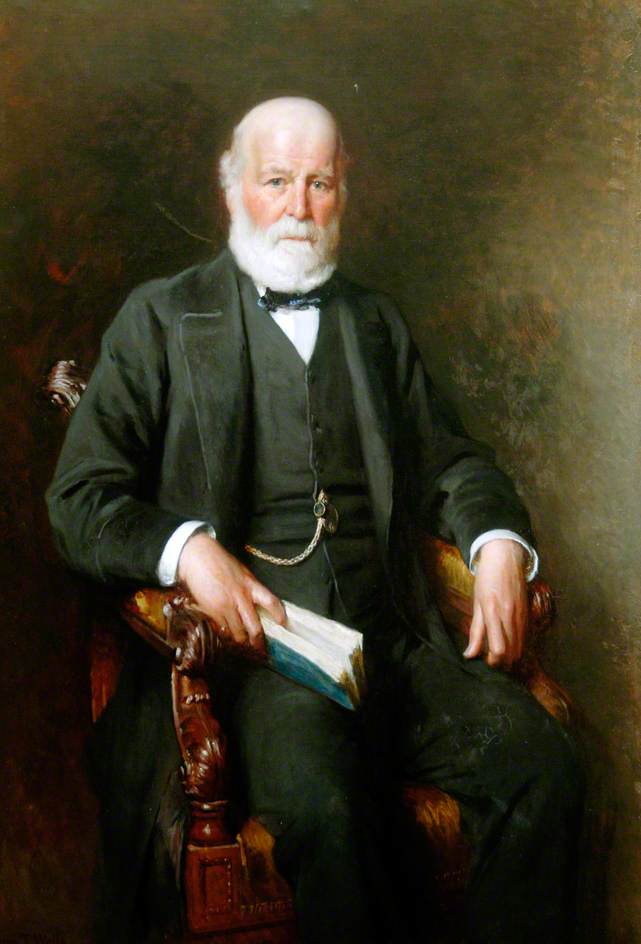
John Corbett (1817 – 1901) was the son of Joseph Corbett, a Shropshire farmer. Joseph Corbett relocated to Birmingham, where he established a successful canal freight business.

John Corbett (1817-1901) by Henry Tanworth Wells. Image used with the kind permission of The Dudley Group NHS Foundation Trust

John Corbett left school at the age of ten, and assisted in driving one of his father’s canal boats. He was eventually promoted to canal boat captain. Corbett observed that salt was one of the major freight goods.

In his spare time, as well as on canal boats, Corbett would read mechanical books, with the aim of becoming an engineer. He served a five year apprenticeship at the Leys Ironworks in Stourbridge from 1840. This practical experience would later prove useful in his later career.

John Corbett was taken into partnership by his father in 1846. However the business was suffering with increased competition from the railways, and was sold to the Grand Junction Canal Company in 1849.

Corbett acquires the Stoke Prior Salt Works
John Corbett found employment at the Stoke Prior Salt Works near Droitwich. He began as an engine driver, before working as an outrider, and finally as a cashier. Corbett was learning the salt business at all levels.

The company that operated the Stoke Prior Salt Works failed, and Corbett acquired the lease to the site from the bank in 1852. The works were relatively small at this time, with an annual production of 26,000 tons of salt. Two successive companies had failed to make a success of the business. Corbett studied the previous failures and endeavoured to make a success of it.

The Stoke Prior Salt Works produced salt from springwater. Underground springs passed through a salt bed, which gave the water a salt content of 38.4 percent, a higher level than even the Dead Sea.

Corbett used his engineering ability to introduce improved salt refining techniques. Identifying distribution as the most profitable area of the salt industry, he acquired his own canal boats, and later trains, to transport his product. To increase export sales he established agents overseas.

Corbett employed at least 500 people at his salt works by 1871. He was probably the largest salt manufacturer in Britain by 1876, with an annual output of 200,000 tons of salt from a 30 acre site.

Corbett hired the best people he could afford, and was a paternalistic employer. He built a village for his workers including a school, church and social clubs. Corbett was also a dedicated philanthropist, establishing a 40 bed hospital in Stourbridge, as well as gifting Salters Hall to Droitwich.

Throughout his career, Corbett remained a hands-on proprietor, deeply engaged in the management of his business. He was an incredibly keen businessman, and a hard worker, beginning his working day at 6am, and often sleeping above his work offices.

By character Corbett was a quiet, likeable man. He was thoughtful, intelligent and interested in the arts and travel. Despite his immense wealth he lived a plain life, and drank in moderation.

Salt was the largest manufacture by tonnage in Britain after coal and iron in 1879. Between one and two million tons were produced each year, and thousands of people were employed in the industry.

Corbett produced up to 300,000 tons of salt per annum, by 1886. High quality table salt was the main product, sold under the “Black Horse” brand.

Men were limited to an eight hour day, and women to seven. Corbett paid his workers a premium of around 15 percent against the industry average. In his entire career, Corbett never suffered a strike that lasted 48 hours or more.

According to an industry estimate, John Corbett held nearly 50 percent of the British salt producing industry by 1888 and the Stoke Prior Salt Works was the most valuable enterprise of its kind in Britain.

The Salt Union
The Salt Union Ltd was formed in 1888 as a merger of various salt interests across the country, including the Stoke Prior Salt Works, which were acquired at the cost of £660,000. Salt Union had a capital of £3 million and produced two million tons of salt every year.

Corbett became deputy chairman, a managing director, and by far the largest shareholder in the concern.

The Salt Union was immediately accused of attempting to rig the market and raise prices. It was alleged in The Standard that salt prices to the strategically important alkali industry had increased by 80 percent.

As a consequence of the price increase, exports slumped by 20 percent, and many people were placed out of work. Corbett initially defended the company, arguing that producers had been operating at an unsustainable loss for a considerable period of time, and that the price adjustment merely reflected a correction of the market.

Corbett was to regret joining the Salt Union. The company had a lack of focus and direction, and his recommendations for the business were ignored. As a result, Corbett resigned his post as deputy chairman and managing director in 1890.

The Salt Union rapidly lost market share. Its attempt to exploit its monopoly position simply allowed its competitors to undercut it. Furthermore, an improved table salt was introduced by rival Cerebos in 1894.

Corbett died due to complications from Alzheimer’s disease in 1901. His net estate was valued at £412,972. An obituary in the Daily Telegraph heralded him as the “Salt King”. The bulk of his estate went to his only surviving brother, Dr Thomas Corbett (1836 – 1906). When Thomas Corbett died he left the bulk of his brother’s estate to various charitable institutions.

The Droitwich works had been practically shut down by 1912.

The Salt Union was acquired by ICI in 1937. The Droitwich works were closed due to the impact of lower-cost foreign imports in 1972.

Ring their praises: Bell Brothers

Bell Brothers was the second largest producer of pig iron in the North of England.

Bell Brothers
Thomas Bell (1774 – 1845) was born at Lowhurst, Cumberland. He entered the business of Losh & Co of Newcastle upon Tyne, a firm of merchants which was branching out into the manufacture of alkali and iron, in 1808. He became a partner in the firm, which became known as Losh, Wilson & Bell.

Thomas Bell’s sons, Isaac Lowthian Bell (1816 – 1904) and John Bell (1818 – 1888), established Bell Brothers in 1844. They leased an iron smelting works at Wylam on Tyne.

Isaac Lowthian Bell (1816 – 1904) by Henry Tanworth Wells. Image used with permission from Middlesbrough Town Hall

Lowthian Bell was the senior partner. Educated in the sciences at the Sorbonne in France, he spoke fluent German, Danish and French. Bell would later be heralded as the first scientifically trained ironmaster.

John Vaughan discovered sizeable deposits of ironstone (from which iron ore could be extracted) at Eston in the Cleveland hills near Middlesbrough.

John Bell made his own ironstone discovery at Normanby, and leased the land from the Ward Jackson family. Two blast furnaces were erected at Port Clarence, Cleveland in 1853. Three more were built the following year.

Bell Brothers was registered as a limited liability company in 1873. The company remained entirely family controlled.

Two new blast furnaces were opened in 1874, and the company announced plans to increase capacity to 750 tons of iron per day.

Bell Brothers pioneered the Teesside salt industry. The company began to bore salt from 1882, and by the end of the year had a productive capacity of up to 400 tons of salt a week. The salt was sold to Tyneside chemical manufacturers, who used it to produce alkali. By April 1883 the company produced 860 tons of salt a week.

By this time, Teesside was the largest producer of iron in the world.

Bell Brothers operated twelve blast furnaces at Port Clarence by 1877. The company also operated ironstone mines, limestone quarries and collieries. Around £1 million in capital was invested in the business. The company was second only to Bolckow Vaughan in pig iron production in the North of England.

Thomas Hugh Bell (1844 – 1931), the son of Lowthian Bell, was responsible for managing the business by this time.

Thomas Hugh Bell (1844 – 1931) in the 1910s. Image used with permission from the National Portrait Gallery

Bell Brothers announced plans to develop a steel works at Port Clarence in 1887. The works would use the Siemens-Martin process, instead of the established Bessemer process, to manufacture steel from Cleveland pig iron. The strategy allowed the company to exit the increasingly competitive iron market.

Bell Brothers employed 4,500 men in 1898. The company had an authorised capital of £825,000.

Bell Brothers divested its salt interests to Salt Union and Brunner Mond in 1899.

Merger with Dorman Long
Dorman Long acquired half of Bell Brothers from Thomas Hugh Bell in 1899. The remaining half was acquired from Lowthian Bell in 1902.

Lowthian Bell became chairman of Dorman Long. With a capital of £1 million, the merged company was the largest iron and steel manufacturer in the North of England.

Bell Brothers produced 360,000 tons of pig iron in 1903. The number of blast furnaces had been reduced to eight by 1905.

Bell Brothers blast furnaces at Port Clarence in 1917

Lowthian Bell died with an estate valued at £768,676 in 1904.

The Bell Brothers subsidiary was formally liquidated in 1923.

error: Content is protected !!