The Slee & Co vinegar works were operated on the same site in London from 1812 until 1992.
Slee & Co was founded by Noah Slee at Church Street, Horsleydown, London in 1812. He was soon joined by Josias Slee (1773 – 1829), who emigrated to London from Honiton, Devon.
John Vickers joined in partnership from 1823, and the business traded as Vickers & Slee.
Josias Slee left the business in 1826.
Vickers & Slee was the fifth largest vinegar brewer in Britain and Ireland by 1832. The firm held about seven percent of the market.
In an age before refrigeration, vinegar was a much more important commodity than it is today, due to its preservative effect on foodstuffs.
John Vickers left the partnership in 1838.
The business was owned by Noah Slee, William Payne and Edward Richardson Slee (1815 – 1878), the son of Josias Slee, in the 1840s. Payne was a brother-in-law.
Noah Slee was declared bankrupt in 1842, and the business continued as Payne & Slee.
Payne & Slee was the fifth largest vinegar brewer in Britain by 1844.
An analysis conducted for The Lancet in 1852 found that Payne & Slee vinegar contained the highest amount of sulphuric acid of any of the major vinegar producers in Britain. The addition of sulphuric acid was a low-cost method of speeding up the acidification process of the vinegar, but it was considered hazardous for health.
Payne left the business in 1860.
The business employed 36 people in 1861.
The business traded as Slee & Slee by 1868.
49 people were employed in 1871.
The Horsleydown site sourced water using an artesian well, sunk to a depth of 303 feet. The water source was of a high quality for brewing vinegar, and had a high content of calcium sulphate and sodium chloride.
Slee, Slee & Co held a stock of nearly half a million gallons (c.2.3 million litres) of vinegar in 1874.
Batty & Co, sauce and pickle manufacturer of Finsbury Pavement, was acquired in 1874.
Edward Richardson Slee died with a personal estate valued at under £60,000 in 1878. His stake in the business was inherited by his son, Herbert Hutton Slee (1853 – 1933).
The business was run by Cuthbert Britton Slee (1818 – 1900) and Herbert Hutton Slee from 1878.
Slee, Slee & Co was one of the longest-established vinegar brewers in Britain by 1887. One of their vats had been in use since the reign of George III (1739 – 1820).
Export sales began in earnest, principally to New Zealand, from 1889.
The business became a limited company from 1895.
Batty & Co was sold to Heinz, who desired a British manufacturing facility, in 1905.
Champion & Co, vinegar brewers of City Road, London was acquired to form Champion & Slee Ltd in 1907. The company had a share capital of £140,000. The takeover was motivated by the scope for economies of scale. The Slee brand was phased out, but all production was relocated to the Slee premises, where there was ample room for expansion.
A large proportion of production was exported to foreign and colonial markets.
Champion & Slee was acquired by Crosse & Blackwell, who merged operations with Sarson’s, in 1929 The Champion brand was phased out in favour of Sarson’s.
Hammonds Sauce Co was the largest privately-owned sauce manufacturer in Britain. Hammonds became best known for its Chop Sauce, a light and spicy brown sauce.
Background
Herbert Bowdin Hawley (1880 – 1952) was born in Grassington, Yorkshire, the son of a farmer of 95 acres.
Hawley left home at the age of 21 with just £10. He worked in a grocer’s warehouse in Halifax, and later as a salesman. He had established himself as director of a soap manufacturing company in Shipley, near Bradford by 1911.
Herbert Hawley entered into partnership with his brother Richard to form H B and R Hawley Ltd, cake flour manufacturers, in 1914. H B Hawley acted as chairman of the company, which had a nominal capital of £50,000 in 1920.
Hammonds Sauce Co
H B Hawley founded a sauce manufacturing company, at Wellcroft Mills, Shipley, in 1924. Initially there were four employees.
As demand increased, additional space was acquired at the site in 1926 and again in 1928.
Expanding sales saw production relocate to a new factory at Dockfield Road, Shipley, from 1930. Hammonds Chop Sauce was introduced from that same year, and soon became the principal product.
The company took on the name of Hammonds Sauce Co from 1933.
Over one hundred people were employed by 1934.
The factory was expanded to accommodate increasing demand for Hammonds Chop Sauce around 1935.
During the Second World War most of the factory was requisitioned by the Admiralty as a storage warehouse, although production of Hammonds Chop Sauce continued.
H B Hawley was a keen bandmaster and composer, and he formed the Hammonds Sauce Works Band in 1946.
H B Hawley died in 1952, and left an estate valued at £27,000. He was hailed as one of the leading bandmasters in Yorkshire. His son, Horace Routledge Hawley (1910 – 1983), took over Hammonds Sauce Co.
Hammonds Sauce Co employed a staff of around 100 by 1954.
Goodall, Backhouse & Co of Leeds was acquired in 1959. Goodall’s were sauce manufacturers best known for Yorkshire Relish.
Hammonds Sauce Co was the largest privately-owned sauce manufacturer in Britain by 1974, with a range of 70 products. 34 million bottles of sauce were sold that year, with a significant proportion exported, largely to the United States. The American market was particularly fond of Hammonds Steak Sauce and Yorkshire Relish.
Horace Hawley retired as managing director in 1975, but continued as company chairman.
Loss of independence
Hammonds was acquired by US food conglomerate Pillsbury, best known in Britain for Green Giant sweetcorn, for £2.4 million in 1982.
Pillsbury centralised all production at a new £1 million factory on Harrogate Road, Bradford from 1985. The Goodall Backhouse factory in Leeds and the Hammonds factory in Shipley were closed.
Pillsbury was acquired by Grand Metropolitan in 1988 who sold the UK business to Dalgety in 1990. Hammonds had an annual turnover of £11 million in 1990.
Hammonds was acquired by Albert Fisher for £12 million in 1991. Albert Fisher ended sponsorship of the Hammonds Sauce Works band after 47 years in 1993.
Hammonds was acquired by Unigate in 1999. The Bradford factory was closed in 2002 and production was relocated to a former vinegar brewery on Whitelees Road, Littleborough, Lancashire.
McCormick, the American seasonings company, acquired Hammonds for £12.2 million in 2003. Hammonds Sauce largely served the catering industry.
The three principal ingredients in Hammonds Chop Sauce are water, sugar and modified corn starch as of 2020. The sauce derives its flavour from acetic acid, spirit vinegar, apple puree, molasses, tomato paste and spices.
Burgess’ Essence of Anchovies was introduced in 1775, and was the first branded sauce to enjoy a nationwide reputation in Britain. Burgess sauce is still sold.
John Burgess introduces Essence of Anchovies
John Burgess (1750 – 1820) was born in Odiham, Hampshire, the son of an affluent grocer. Burgess served an apprenticeship in London before he established his own premises at No. 101, the Strand by 1774. Burgess held the profession of “Italian warehouseman”, meaning he sold imported speciality foods such as hams and olive oil.
Burgess developed his reputation due to his keen business skills and his honesty. Growing trade saw the business relocate to larger premises at No. 107 the Strand from 1779.
Burgess introduced his Essence of Anchovies in 1775, and it was his best known product by 1788. The recipe was simple: anchovies were crushed, mixed with water and gently heated. Spices may have been added, and the sauce was strained.
His was the original Essence of Anchovies, but it inspired imitations from the likes of Elizabeth Lazenby, who began to sell her anchovy-based sauce from 1793.
His only son, William Robert Burgess (1778 – 1853), entered into an equal partnership with his father from 1800, and the firm became known as John Burgess & Son.
Burgess products were onboard Admiral’s Nelson’s HMS Victory in 1805. Lord Byron referenced Burgess’s fish sauce in his poem Beppo (1817). The novelist Walter Scott claimed that Burgess made the best fish sauce in 1823.
The second and third generation take control of the business
John Burgess died in 1820, and William Robert Burgess became sole proprietor.
By the early 1850s, due to public demand, Essence of Anchovies was adulterated with Armenian bole, an iron-rich clay, to imbue the sauce with a bright red colour. This was the standard industry practice at the time.
By the 1850s Lazenby and Crosse & Blackwell were encroaching upon Burgess’s market share with lower-priced imitations of Essence of Anchovies. W R Burgess stubbornly announced that the only change to Essence of Anchovies production that he would allow would be that twelve days pounding of fish by two men could be altered to six days pounding by four.
After the death of W R Burgess, the business was taken over by his wife, Elizabeth (1804 – 1884) and his son, Arthur Wellington Burgess (1840 – 1900).
A fire broke out at the firm’s pickling vaults and storehouses on the Strand in 1869. A large quantity of olive oil was destroyed.
Arthur Wellington Burgess was declared bankrupt in 1870, and the business was taken over by his mother and his sisters, Mary Ann Burgess and Louisa Elizabeth Burgess.
The Brooks family acquire control of John Burgess & Son
The business was acquired by the Brooks family, relatives of the Burgesses, in 1874.
John Burgess & Son was incorporated as a limited company in 1901.
The company relocated its manufacturing and offices to Hythe Road, Willesden in 1908.
The company was appointed purveyors to George V in 1911. That same year, Robert Falcon Scott took several bottles of Burgess’ Essence of Anchovies with him to the Antarctic.
The shop on the Strand was closed in 1914.
A Burgess gravy browning bottle from the mid 1990s
A takeover offer from George Mason & Co, the manufacturer of OK Sauce, was rejected in 1928.
The Willesden factory was damaged by German bombs in 1940.
John Burgess & Son is acquired by Rayner & Co
Rayner & Co acquired John Burgess & Son from the company directors, who were the sole shareholders, in 1954. Company operations were relocated to Edmonton, North London in 1960.
Burgess creamed horseradish was launched in 1960, following three years of research.
Rayner & Co had sales of just under £2 million in 1971. Burgess creamed horseradish was by now its leading product, a market leader in its field with sales of £100,000 a year. Sales of Essence of Anchovies had steadily declined from their Victorian heyday. Rayner & Burgess was established to jointly handle the increasing sales of both companies in 1972.
Burgess creamed horseradish was still available as late as 1993. It was a premium product.
Essence of Anchovies was still being produced as late as 1999. Latterly, its fans had included the celebrity chef Simon Hopkinson.
Rayner Burgess entered into liquidation in 2007. The Burgess brand was acquired by Greencore, a large Irish foods company. Burgess pickles and sauces continued to be sold as late as 2016. Burgess Gravy Browning is still produced for the catering trade and Asian export markets.
Champion & Co became the fourth largest vinegar brewer in Britain and Ireland.
The Champion family establish and grow the business
Champion & Co, vinegar brewers, traced its establishment to 1705.
In an age before refrigeration, vinegar was a much more important commodity than it is today, due to its preservative effect on foodstuffs.
William Champion (died 1799) had acquired a London vinegar brewery by 1794. The premises were situated in Shoreditch, on the corner where City Road meets Old Street, next to where the Old Street tube station is today.
Thomas Champion and Guy Champion
William Champion died suddenly whilst serving as Sheriff of London in 1799, and the business was passed to his son, Thomas Champion (1774 – 1846). The venture was to owe its subsequent growth, both at home and overseas, to the business acumen of Thomas Champion.
A bottle of Champion’s Celebrated Pure Malt Vinegar, likely dating from the 1920s
Thomas Champion was joined in partnership by a Francis Moore between 1813 and 1818, and the firm trade as Champion & Moore.
The firm traded as Champion & Green from 1821, after a Thomas Green entered the business. The firm had expanded into mustard production by 1830.
Guy Champion (1786 – 1846), brother to Thomas Champion, who had previously worked as a merchant in Spain, entered the business from 1830.
Guy Champion chanced upon a slave auction whilst abroad in Albania, and acquired a girl. He brought her back to England and married her.*
Champion & Green was the fourth largest vinegar brewer in Britain and Ireland by 1832, with a market share of 13 percent.
Thomas Green had left the business by 1839.
In 1840 the partnership between Guy and Percival Champion, Arthur Mann and William Henry Wright was dissolved. They had been trading under the name Champions, Mann & Wright. The business was transferred to Thomas Champion.
Guy Champion died in 1846. Thomas Champion died suddenly whilst organising the funeral arrangements for his brother.
George Willis and William Henry Wright took over Champion & Co, although the Champion family continued to hold a stake in the business.
James Bigwood takes control of Champion & Co
James Bigwood (1839 – 1919) was the son of a successful fish merchant. He acquired control of Champion & Co in 1868 and became managing director. Bigwood was an enthusiastic advocate of product purity, and was vehemently opposed to food adulteration.
James Bigwood (1839 – 1919) in 1898. Image used with the kind permission of the National Portrait Gallery.
Champion & Co produced well over 1.5 million gallons of vinegar every year by 1872. Two tons of mustard were produced every day. 170 people, mostly skilled workers, were employed.
The vinegar brewery was extended in 1873.
A large export market was developed in Australia and New Zealand.
A new 53,000 gallon vinegar vat was installed in 1883. It was constructed over three months from Kentish oak. It joined 46 other similarly-sized vats at the brewery.
The five and six-storied premises covered 4.5 acres of land by 1885.
Champion & Co was one of the largest mustard manufacturers in the world. Three million tins of mustard were produced per annum by the mid-1880s.
James Bigwood was elected as a Member of Parliament in 1885. Bigwood measured 6 ft 4 inches, and held the distinction of being the tallest MP. The Daily Mirror described his appearance as that of a “prosperous doctor”.
Champion & Co could produce up to 10,000 bottles of vinegar a day by 1894.
A Champion & Co bottle, believed to date from the 1890s. Image courtesy of Tim Gunnink
James Bigwood had been joined in business by his son, James Edward Cecil Bigwood (1863 – 1947) by 1901.
Champion & Co was the longest-established vinegar brewery in London by 1907.
The Bigwood family sell Champion & Co to Slee, Slee & Co
James Bigwood and J E C Bigwood sold Champion & Co to Slee, Slee & Co, a rival London vinegar brewer, in 1907. The merged business was registered as Champion & Slee, with a share capital of £140,000.
The City Road brewery, with its proximity to the City of London, had become highly valuable, and the Bigwoods were keen to realise its value. The Champion brewery site was demolished, and the land was used to build affordable housing. Champion & Co production was relocated to the Slee premises at Tower Bridge Road, where there was ample space for expansion.
Champion & Slee received a Royal Warrant to supply King George V in 1913.
The British vinegar industry suffered from overcapacity after the First World War. Champion & Slee was acquired by Crosse & Blackwell in 1929. Crosse & Blackwell closed down its own vinegar brewery and concentrated production at the Champion & Slee site.
Champion & Slee established a factory in Sydney from 1930. It produced 1.8 million bottles annually.
Champion’s vinegar continued to be advertised in Britain until the mid-1950s, after which it was phased out in favour of the Sarson’s brand, which was also owned by Crosse & Blackwell.
Champion’s vinegar continued to be sold in the Australian market until at least the late 1970s.
Notes
* According to to an account by Charles James Feret (1854 – 1921) in 1900.
Pink’s was the largest producer of jam and marmalade in the world by the late nineteenth century.
Edward Pink era
Edward Pink (1827 – 1910) was born in Durley, Hampshire. He relocated to London where he served an apprenticeship to a grocer. He established a preserves business in Holborn from 1860.
Thomas Pink (1855 – 1926)
His son, Thomas Pink (1855 – 1926), entered the business from 1867, at which point there were twelve employees. Edward Pink Jr later entered the business, and the firm became known as Edward Pink & Sons.
A factory had been established on Staple Street, Bermondsey, South London, where there was ample room for expansion, by 1871. The operation utilised steam-powered machinery by 1874. Over 400 people were permanently employed, rising to 600 during the busy seasons.
Scrupulous cleanliness was adhered to. The influential Dr Arthur Hassall (1817 – 1894) of The Lancet toured the company’s factory in 1874 and following scientific analysis of Pink products was able to vouch for their purity. Food adulteration was rife at the time, so this recommendation was hugely valuable for the firm.
Edward Pink & Sons added a small amount of apple jelly to its marmalade from 1874, in order to mellow the bitterness of the Seville oranges.
Edward Pink & Sons claimed to be “the largest manufacturer of preserves” by 1879. The firm catered largely to a working class market.
Edward Pink & Sons employed 263 men and 366 women, a total of 629 people, by 1881. From this time the firm added glucose to their jam, with the claim that this greatly improved the product.
Over 3,000 tons of jam were produced every year by 1882.
Edward Pink & Sons claimed to have the largest jam factory in the world by 1883. The factory site covered 4.5 acres by 1887.
E & T Pink
Thomas Pink became managing director of the firm from 1890, which henceforth became known as E & T Pink. Pink was a bold man, strong-willed and forthright. He was also hard-working, and a hands-on employer. Immediately after taking control of the business, he completely reorganised it.
In response to alleged intimidation of union members in 1892, the activist Clement Edwards (1869 – 1938) urged the Co-operative societies to boycott Pink products.
60 female workers in the finishing department went on strike in 1892 after their wages were reduced. They were all promptly replaced by new workers.
E & T Pink did not allow its workers to leave the premises during their lunch break, and did not provide a separate room where staff could rest during their break. A juryman described the situation as “shameful” in 1893. Following an appeal by John Burns MP (1858 – 1943) to Thomas Pink, permission was granted for outside breaks, and Pink opened a four storey, 1,000 seat capacity “mess house” for employees in 1894. It was probably the best-equipped staff building in London, according to the St James’s Gazette. Thomas Pink denied that this was an act of philanthropy, and stated his belief that treating his employees well would increase profits at his business.
There were 500 regular workers at E & T Pink by 1893, around 400 of whom were women. That year, 8,000 tons of jam were produced.
Edward Pink Sr retired in 1894, and Thomas Pink became sole proprietor of E & T Pink.
Pink employed 56 salesmen, 130 clerks, and over 1,800 workers during the busy season in 1894. His steam engines had a total of over 1,000 horse power. The factory covered ground of 4.5 acres, and had a floor space of eight acres.
E & T Pink was the largest manufacturer of jam in the world in 1894, with an average production of 40 tons per day. Pink controlled a twelfth of the British tapioca market. E & T Pink also claimed to be by far the largest manufacturer of marmalade in the world by the late nineteenth century.
Advertisement from 1890
Thomas Pink was a highly-gifted engineer: he designed the machinery for his pepper mills himself; he ground sixteen tons of pepper a week by 1894, and controlled an eighth of the British pepper trade.
Pink was innovative; he was the first British businessman to dictate his correspondence by phonograph. He conducted the majority of his business through the newly-invented telephone by 1894. A keen Conservative, Pink received a knighthood in 1904.
By appointing skilled heads of department, Sir Thomas Pink was able to reduce his time spent at E & T Pink. Pink preferred to find and promote from within his own business, in preference to hiring managers externally.
The Staple Street factory covered 7.5 acres of ground, with 15 acres of floor space, by 1899. There was a pepper mill at Hatcham, and two wharves at Horsleydown. A total of 2,000 people were employed. 10,000 tons of jam and marmalade were produced every year.
In 1901 Sir Thomas Pink estimated that he lost £1,000 to £1,500 a year due to petty thefts by his 2,500 employees.
Edward Pink died with an estate valued at £261,677 in 1910.
Profitability trouble and labour issues
E & T Pink was registered as a company in 1912.
Between 1910 and 1914 the business suffered heavy losses.
The factory was affected by a woman’s strike in 1911. The female workers managed to secure a wage increase of two shillings per week.
Pink’s women strikers in 1911
The Pink factory suffered a serious strike of around 1,000 people in 1914, involving most of the workforce except the clerical staff. The employees demanded an increase in their wages. Pink’s response was to close the entire factory, citing safety concerns for those among his workforce who remained loyal. This left a total of 1,200 to 1,500 people idle. Work resumed after Pink agreed to grant the minimum wage recommended by the Trade Board.
During the First World War, wartime contracts allowed E & T Pink to re-enter profitability, but following the end of the war, the losses returned.
A cooperage fire at Pink’s factory caused £20,000 worth of damage in 1918.
Sir Thomas Pink retired in 1919, and sold E & T Pink to the Van Den Bergh family.
Plaistowe merger and demise
E & T Pink was merged with Plaistowe, a fellow jam, marmalade and confectionery manufacturer, in 1920. The merger was motivated by anticipated economies of scale.
The merged company had an annual production of 24,000 tons of jam and marmalade, 7,500 tons of confectionery and 2,500 tons of Fulcreem food products. Total sales were over £2.75 million.
The company directors agreed that the Pink’s name had become noxious by 1921, and that a rebranding was necessary to increase sales.
After sustaining losses of £200,000 between 1920 and 1923, the E & T Pink subsidiary was liquidated, and the assets acquired by Plaistowe.
Following the merger, Sir Thomas Pink was retained in an advisory capacity, but had no directorial control. A keen smoker, drinker and meat eater, he died from heart failure at his London home following surgery in 1926. He left an estate valued at just over £275,000.
In his will Sir Thomas awarded a £750 annuity to his son, Thomas Bernard Pink (born 1882), who had emigrated to Canada in 1913, and after establishing himself in the Toronto real estate business, had not been heard from since 1914. It was believed that he enlisted in the Canadian army under an alias, served in France and became a casualty of war.
Plaistowe entered into receivership in 1926. This was blamed on losses made by the Pink side of the business, as well as the mismanagement of the merger of the production of the two firms. Plaistowe was acquired by Crosse & Blackwell in 1930, who merged operations with their Keiller jam and confectionery subsidiary.
The Bermondsey factory was demolished in 1935, and replaced by a housing estate.
Imperial Tobacco dominated the British tobacco trade throughout much of the twentieth century.
Background and formation
Wills of Bristol employed about 1,000 workers by 1889. The business was best known for the Woodbine brand. Informed by their Congregationalist principles, the Wills family had, by 1895, introduced financing for a staff canteen, a convalescent home, a sanatorium, a resident nurse and doctor, paid holidays and a number of recreational clubs.
Imperial Tobacco was formed in 1901 by the merger of thirteen leading British tobacco companies. Wills controlled the combine with just over half of the equity, followed by Lambert & Butler of London, Mitchell of Glasgow and John Player of Nottingham.
It was a defensive merger following the acquisition of Ogden of Liverpool, one of Britain’s leading cigarette manufacturers, by the highly capitalised American Tobacco Company.
The businesses in the combine retained their own brands and salesmen, but pricing and accounting were organised centrally.
Salmon & Gluckstein, a retail tobacconist with 184 branches, was acquired for over £1.25 million in 1902, largely to prevent its acquisition by American Tobacco.
American Tobacco sold Ogden to Imperial in 1902, and both companies agreed to avoid its rivals’ domestic market. The global market was to be catered for by a new company called British American Tobacco, with a two third stake held by American Tobacco and one third held by Imperial.
Domination of the British tobacco market
Imperial Tobacco estimated it had “rather over 50 percent” of the British tobacco market by 1904. Woodbine was the highest-selling cigarette brand in the world.
Imperial Tobacco employed over 10,000 people by 1909, and three quarters of the workforce were female.
Imperial Tobacco held 87.5 percent of the British tobacco market in 1913. This share had declined to 72.5 percent by 1920, but included 91 percent of all cigarette sales.
Imperial Tobacco was the largest British public company by 1926.
Imperial Tobacco had seen its virtual monopoly on cigarettes corroded by the re-emergence of competitors such as Carreras, Gallaher and Godfrey Phillips by the late 1920s.
Imperial Tobacco employed 40,000 people across 27 factories by 1933.
Imperial Tobacco was the second largest industrial company in the world by 1937, outranked in market capitalisation by only General Motors.
John Player overtook Wills to become the largest single Imperial Tobacco subsidiary in the 1940s.
Imperial Tobacco held 78.8 percent of the British tobacco market in 1955.
Imperial Tobacco was the third largest company in the world outside the United States as measured by sales in 1957.
Wills Embassy was introduced as a filter cigarette from 1962. It was an overnight sensation, and was the highest-selling filtered cigarette in Britain by 1963. Embassy was the overall leading cigarette in Britain by 1965.
Imperial held 66 percent of the British tobacco market in 1968, followed by Gallaher (Benson & Hedges) with 29 percent. Carreras (Rothmans, Dunhill) was third in the market with a seven percent share.
Relative decline of the business
Imperial Tobacco diversified away from tobacco from the 1960s and changed its name to Imperial Group in 1973.
Imperial Group’s share of the British cigarette market had declined to just 37 percent by 1986.
Hanson Trust acquired Imperial Group for £2.7 billion in 1986.
Hanson Trust sold off non-core assets, such as the Courage brewing business to Elders for £1.4 billion, the hotel and restaurant business to Trusthouse Forte for £190 million, and the Golden Wonder crisps business to Dalgety for £87 million. The Ross Youngs frozen seafood business was sold to United Biscuits for £335 million. The sauces business, including Lea & Perrins and HP, was sold to BSN for £199 million.
The core tobacco business was reorganised. The range of products was reduced from 44 to 11, with a focus on five core brands. Five factories were reduced to three, with 1,000 redundancies.
Imperial Tobacco was demerged from Hanson Trust in 1996.
The ABC tea shop was a ubiquitous part of early twentieth century London life, mentioned by T S Eliot and Virginia Woolf, and lambasted by George Orwell.
Origins
The Aerated Bread Company (ABC) was incorporated in London with a nominal capital of £500,000 in 1862. The business was formed in order to manufacture bread using a new patented process which used carbon dioxide instead of yeast.
As a mass producer of bread, ABC had a large number of contracts with institutions such as schools and hospitals. It also had a number of retail outlets in London from which its sold bread and cakes directly to customers.
Establishment of the ABC tea shop chain
In 1884 Miss Turnbull, a manager at a ABC bakery shop near London Bridge Station, suggested to the company directors that on-site sales of tea might increase revenues. Her suggestion was to prove successful, and soon all the ABC outlets sold tea as well as bread and cakes.
Competitors sold pre-prepared tea from a large container, and the quality was variable. ABC differentiated itself by preparing fresh tea to order.
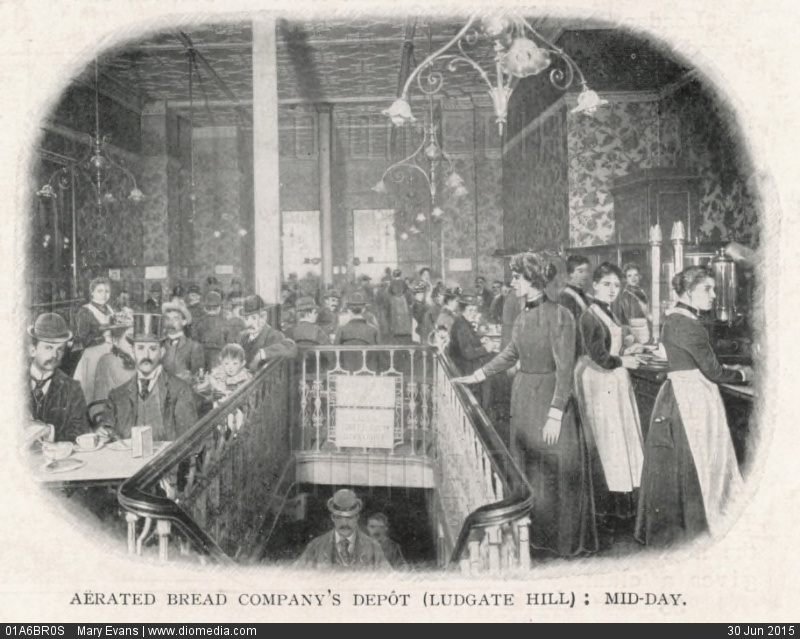
The tea shops proved popular among clerical workers, who appreciated their affordable prices, and there were around 70 outlets by 1889.
An ABC shop at Ludgate Hill, date unknown
Production at a centralised bakery in Camden Town from 1891 helped to keep costs low.
ABC did not escape criticism however; it became notorious for the meagre pay it gave its waitresses, who worked a 62-hour week.
ABC appears to have begun to exploit its monopoly position. Leo Chiozza Money (1870 – 1944) complained:
very high prices [were charged]. The shops were not attractive. The ABC scheme of decoration [was] simply appalling. The food was very plain and the portions served … were stingy.
Increased competition from J Lyons J Lyons opened its first tea shop in 1894. Lyons branches were more upmarket and better managed than the ABC shops.
ABC transitioned its tea shops into affordable restaurants, with enlarged menus, in order to compete with Lyons.
Lyons had more central London outlets than ABC by 1911.
ABC served over 1.25 million customers across 150 branches in 1911. A contemporary commentator indicated that service was slow, but the quality of the tea was “beyond reproach”.
New management from Buszard
ABC acquired W & G Buszard, a London bakery chain with 140 shops, including the prestigious Criterion restaurant in Piccadilly, in 1918. ABC were attracted to the merger by the strong management team at Buszard. Buszard directors, led by Charles Cottier (1869 – 1928) and Frederick Hutter (1876 – 1927), quickly came to dominate the ABC board, with Cottier serving as chairman and Hutter as managing director.
Cottier was a forceful personality, and under his leadership ABC undertook numerous acquisitions from 1919. These were Bertram & Co (railway catering), James Cottle (Liverpool and Manchester restaurants), Cabins, JP Restaurants (with 80 outlets around London), Newberys (shop-fitters), Abford Estates (a large property development) and a controlling interest in W Hill & Sons (29 shops), at a combined cost of just under £500,000.
Frederick Hutter was described as the “Napoleon” of the London catering trade. He came from humble origins, and had begun his career as a baker’s assistant.
ABC operated 200 to 250 tea shops and restaurants by 1922. The manufacturing site at Camden Town covered over four acres.
ABC had 156 branches across London in 1926. That year also saw the prim black and white “Victorian” waitress uniforms replaced by blue dresses.
ABC opened the largest tea shop in Britain, opposite Victoria Station, in 1926. The site was bought from the Duke of Westminster, supposedly for £500,000.
Hutter died in 1927, and Cottier died the following year. It appears that the business suffered following the loss of their strong leadership.
Following a spate of low profits, Sir W H Peat (1878 – 1959), the well-known accountant, was contracted to perform an independent review of the company in 1929. Peat argued that the numerous recent acquisitions did not tie in with the core ABC business, and as such, very few economies of scale could be made. He also argued that the company had paid excessive dividends, and had failed to update and modernise its shops, which had become run-down.
The manufacture of aerated bread ended in 1954.
Allied Bakeries rejuvenates ABC
ABC had 164 outlets and was the second largest restaurant chain in Britain by the mid-1950s. However the business had become loss-making.
ABC was acquired by Allied Bakeries, controlled by W Garfield Weston (1898 – 1978), for £2.9 million in 1955. Allied Bakeries were motivated by the opportunity to increase the number of outlets for their bread and biscuits. Allied Bakeries had also privately valued the ABC real estate assets at between £1.7 million and £2 million.
Allied Bakeries sold six or seven ABC sites in central London for £1 million. The money was used to invest in the ABC business. The Camden Town factory was modernised. Unprofitable branches in the West End of London were sold, and new outlets opened in the suburbs. Shops across the chain were refurbished to bring them in line with competitors.
Allied Bakeries sold the Abford House subsidiary, which consisted of a large freehold property in Victoria, London, for over £500,000 to Spiers & Pond, a hotels and catering company, in 1959.
The previously loss-making venture had become one of the most profitable subsidiaries of Allied Bakeries by 1959. ABC reported a profit before tax of over £850,000 in 1962. A pre-tax profit of £735,000 was reported in 1966.
Decline of the ABC tea shop
Trade at the tea shops began to decline from the 1960s and into the 1970s. Rising ingredients costs had rendered handmade cakes an unaffordable luxury. 20 ABC tea shops were closed in 1975, and a further 35 the following year. 30 more were closed in 1976. Some outlets switched to a takeaway sandwich model.
Production of hand-finished cakes at the Camden Town site was ended in 1976, resulting in the loss of over 400 jobs. Bread production also ended.
The Camden Town site was antiquated and unsuited for modern production, and it was closed with the loss of 200 jobs in 1982. The remaining ABC tea shops also disappeared at around this time. The Camden site was demolished a few years later, and a Sainsbury’s supermarket now stands in its place.
Maypole Dairy was easily the largest retailer in Britain by 1913.
The Watson brothers and George Jackson
George Watson (1861 – 1930), Charles Henry Watson (1863 – 1927) and John Alfred Watson (1865 – 1931), were brothers born just outside Coventry to a prosperous farming family. They served as apprentices and later as assistants to George Jackson, a Birmingham dairy merchant.
Jackson had pioneered the sale of pure dairy butter at affordable prices by importing the product directly from Danish farmers. Jackson sold 30,000 tons of butter every year by 1893, and was the largest retailer of butter in the world.
Establishment of Maypole Dairy
Jackson’s strong reputation for butter meant that he was reluctant to branch out into margarine, which although gaining in popularity, was hampered by a downmarket image. However George Watson was free to take the chance, and he established the Maypole Dairy Company, with a margarine shop in Wolverhampton, from 1887. He was soon joined by his brothers, and outlets were opened across the Midlands. The shops also began to sell cheese and butter.
Maypole Dairy was a high volume, low margin business, and outlets were concentrated in working class areas.
Charles Watson was largely responsible for the expansion of the Maypole chain into Lancashire and Yorkshire.
George Watson introduced a profit-sharing scheme for management from 1890. Shortly afterwards, in a pioneering move, the scheme was extended to all employees.
Maypole Dairy was the largest retailer of margarine in Britain by 1895. The business had 60 shops, eight creameries in Ireland and one in England, and purchasing offices in Denmark and Sweden.
Maypole merges with George Jackson
Maypole and George Jackson underwent a merger in 1898, and the company was incorporated with a share capital of £1 million. George Watson became chairman. The company had 185 retail shops and 17 creameries.
Maypole acquired a margarine factory in Godley, Manchester, from Otto Monsted Ltd, a Danish company, in 1902. It was capable of producing 200 tons of margarine every week.
Maypole had 560 retail shops by 1908, and was the largest retailer of tea, butter and margarine in the United Kingdom.
A Maypole Dairy Store in Hartlepool
Maypole reported a net profit of over £550,000 (£425 million in 2015) in 1912, of which all but £50,000 was distributed among shareholders as a 212.5% dividend.* By this time there were 712 stores across the United Kingdom, and the leading lines were margarine and tea. That year, George Watson was appointed a baronet.
Maypole was the largest retail chain in Britain by a substantial margin by 1913, with over 800 shops.
Maypole, and the Dutch producers Jergens and Van den Bergh produced most of the margarine sold in Britain, with Maypole producing almost as much as the other two combined by 1913.
The Manchester margarine factory was sold to Lever Brothers in 1914.
Maypole acquired Otto Monsted’s margarine factory in Southall, Middlesex, and an edible oils refinery in Erith, South East London in 1915. The Southall factory covered 22,500 square yards, employed around 650 people and was the largest margarine factory in the world. It had a weekly output of 700 tons of margarine.
The Southall factory
Maypole margarine differed from competitors in that it was produced from tropical nuts and seeds rather than animal fats. Maypole established a groundnut operation in West Africa to provide raw material for margarine production in 1915. 25,000 to 30,000 tons of groundnuts were produced annually by 1919.
Maypole dominated the sale and manufacture of margarine in the United Kingdom, with a 50 percent market share by 1918. The Southall site produced over 2,000 tons a week. Margarine accounted for 85 percent of Maypole sales.
The interior of a Maypole Dairy shop
Acquisition by Home & Colonial
Maypole capital amounted to £3 million (equivalent to just under £1 billion in 2015) in 1919. Turnover exceeded £36.5 million (£13.8 billion in 2015) in 1921.
However shortly afterwards the company began to struggle with increased Dutch competition and the failure of its West African business. Six directors retired in 1924, including the chairman, George Watson, and they sold their stakes to Home & Colonial. Now the majority owner, Home & Colonial was itself controlled by Jurgens.
Maypole increased its product lines to include jam, marmalade and lard from 1925. In 1928 biscuits were added, and cheese was re-introduced in packaged form.
Maypole is absorbed into Unilever
Maypole had over 1,040 retail outlets and a total capitalisation of over £9 million by 1929. That year, Jurgens and Van den Bergh merged with Lever Brothers of Britain to form Unilever. Maypole was now contractually obliged to purchase all of its margarine from Unilever. The Maypole manufacturing site at Southall was rendered redundant by the Unilever purchase, and was re-appropriated for the production of Wall’s sausages and ice cream. The Erith refinery was also closed.
Unilever created a holding company for its grocery chains; Lipton, Home & Colonial and Maypole Dairy, called Allied Suppliers, in 1930. Allied Suppliers had a capital of £13.3 million, and was the largest grocery retailer in the world. Each retail company continued to be run independently, but there was co-operation in wholesale acquisitions and distribution.
George Watson died in 1930, leaving an estate valued at over £2 million (about £805 million in 2015).
Maypole’s West African venture was sold to the United Africa Company, which was controlled by Unilever, in 1931.
Maypole sold over 200,000 eggs in 1938.
There were 977 Maypole stores and 6,334 employees in 1939. Rivals such as Tesco, which utilised bulk purchasing from suppliers, began to challenge the vertical integration model practised by Maypole.
By 1943 all but two company directors, and practically all senior executives, were men who had started at the bottom ranks of the company and worked their way up.
Faced with continued rationing after the war, Maypole began to extend its product range to include additional staples such as bacon from 1947.
The Maypole name is phased out
The independent management of Maypole ended in 1964. The Maypole name was phased out in the 1970s, when increased competition from supermarkets saw Allied Suppliers decide to concentrate on their Home & Colonial brand. Allied Suppliers eventually morphed into Safeway (UK), and the rights to the Maypole brand are now owned by Morrisons Supermarkets.
Unilever continued to hold a 30 percent share of the global spreads market, until the divested their spreads unit in 2017.
* Currency conversions are calculated by measuring wealth relative to the total output of the economy at the time. All calculations are from measuringworth.com
Vestey Brothers was the largest meat business in the world. The business controlled one third of the refrigerated storage capacity in Britain and two thirds of multiple butchers shops. It accounted for 20 percent of all meat imported into Britain. The Vesteys became the second wealthiest family in Britain after the Royals.
Origins and early growth
William Vestey (1859 – 1940) and Edmund Hoyle Vestey (1866 – 1954) were born to Samuel Vestey, a Liverpool provisions merchant. The two brothers began their commercial lives as office boys working for their father.
William Vestey was sent to Chicago, the centre of the North American meatpacking trade, to scout for opportunities in 1876. He was surprised at the amount of meat that was wasted. He decided to can the surplus meat as corned beef and export it to Britain.
William Vestey (1859 – 1940)
William Vestey relocated to Argentina and began to export frozen partridges from 1890. Later, beef and mutton were added. Being among the first to realise the potential of refrigeration gave Vestey Brothers a competitive advantage against its rivals.
Vestey Brothers established Union Cold Storage as a subsidiary to manage their meatpacking and distribution network from 1897.
Vestey Brothers began to import eggs and chicken from China from 1906. Eggs had previously had poor availability, and Vestey’s low-cost frozen egg mix was to be a major factor in the subsequent growth of catering companies such as J Lyons.
Vestey established Blue Star Lines, a fleet of refrigerated vessels, with two second-hand steamers, in 1909.
The First World War
The business grew rapidly during the First World War, following a surge in meat prices.
Vestey Brothers acquired ranches and freezing works in Brazil, Argentina and Venezuela between 1913 and 1920.
Blackfriars Lighterage & Cartage Co was acquired in 1914, to give the company full control of its distribution in London.
Six million acres of land in the Australian interior were acquired during the First World War.
The Vesteys relocated their business headquarters from Britain to Buenos Aires in 1915 in order to avoid income tax, which had been increased in order to fund the war in Europe.
Vestey Brothers provided cold storage facilities free of charge for British supplies at Havre, Boulogne and Dunkirk during the First World War.
Inter-war period
Vestey Brothers had operations all over the world, and a capital of over £20 million by 1919. It was one of the largest British industrial concerns, and larger than all the other British freezing and cold storage companies combined. In meat-packing, only the American concerns of Armour and Swift were larger.
Vestey acquired £7 million of beef from the British government in a single deal in 1920.
Eastmans, with a chain of butchers shops in Britain, was acquired in 1920.
Union Cold Storage was the largest cold storage company in the world by 1920, with a share capital of £4,780,000 and a storage capacity of over ten million cubic feet. The Blue Star Line was the largest refrigerated fleet in the world.
William and Edmund became so rich that they didn’t live off the interest of their wealth, but the interest of the interest. William was raised to the peerage in 1922.
Union Cold Storage spent £4 million to acquire the subsidiaries of the Western United Investment Company in 1923. This included the British & Argentine Meat Company, James Nelson & Sons and Fletcher’s butchers shops.
Vestey Brothers was the largest meat business in the world by 1923.
Vestey Brothers acquired the Liebig company’s freezing facility at Fray Bentos in Uruguay in 1924.
Vestey Brothers was the largest retailer of meat in the world by 1925, with a chain of 2,035 butchers shops in Britain. Vestey was responsible for 25 percent of the meat that was exported from South America.
Union Cold Storage employed over 30,000 people, with a capital of £9.6 million, in 1925. It had over 450,000 cattle on ranches in Australia, South America and South Africa. The company handled 20 percent of Britain’s frozen meat imports, and operated a third of the country’s cold storage capacity.
Union Cold Storage was the tenth largest British public company by 1926.
Vestey Brothers opened a new refrigeration plant in Buenos Aires, Argentina in 1927. With an annual capacity of 1.5 million cattle and 2.5 million sheep, it ranked among the largest in the world. The plant employed 3,000 people.
Vestey Brothers acquired William Angliss & Co, the largest meat business in Australia, in 1934.
Blue Star Lines had grown to include a fleet of around forty vessels by 1939.
Deaths of the founders
William Vestey conservatively valued Vestey Brothers at over £90 million in 1940. The family became the richest in Britain after the Royals.
William Vestey died in 1940, and was remembered as a modest and benevolent man. During the height of the Blitz he had continued to put in a full working day in London.
Edmund Vestey never retired. He collapsed at his office desk in 1954 and died the following day. Remembered as a shy and reticent man, he left an estate valued at £737,738.
The latter half of the twentieth century
The company retained its position throughout much of the rest of the century. In 1968 it was still the largest cold storage operator in Britain, and had also become a leading supplier of chicken. It remained on par in terms of scale with Armour and Swift.
A legal tax avoidance scheme operated by the Vestey family was revealed in 1980, to public outrage.
Vestey Brothers was considered to be the largest privately owned multinational in the world in the 1980s. It was the largest retailer of meat in the world.
Vestey sold off five of its seven North Australian ranches in 1984. Before the sale it had been the largest private landowner in Australia. After the sale it still raised about ten percent of all cattle in the country.
Speculation on the property market saw Union Cold Storage hampered by short term debt of £423 million by 1991.
Vestey announced it would close 600 of its 1,000 Dewhurst butchers shops in 1992. The business had been adversely affected by the growth of the supermarket chains.
Both Dewhursts and Union Cold Storage entered into administration in 1995. 213 of the Dewhurst shops were saved by a management buyout. The remnant Australian estates were sold off in 1996. The Blue Star Line was sold to P&O Nedlloyd for £60 million in 1998. The sale of the fleet allowed the group to finally re-emerge free of debt.
Vestey Group continues to trade today as a smaller organisation, focused on the sourcing, distribution and processing of meat. The Vestey family are still wealthy: they ranked 160th on the Sunday Times Rich List in 2015, with an estimated fortune of £700 million. Actor Tom Hiddleston is a direct descendant of Edmund Vestey.